
Arwanak, 2025
tags: linguistics, Theia, warp drive, complex kabbalah, systems, cybernetics, Hermeticism
A cry goes unanswered-that of all the gnostics, existentialists and mystics. Reality and the world with it, while being the most complex and dynamic system that could possibly be known, is still wholly incomplete. Modern science, with its basis on materialism and logical positivism therefore has nothing to offer; only speculative gestures based on determined nomologies, topologies, linear sequences and potentials that specifically coincide with known possibilities of the highest chance. The question then arises: “How is it possible to know the impossible?”. This question, as a basic metaphysical inquiry has been explored for the past two millennia of philosophy and learning.
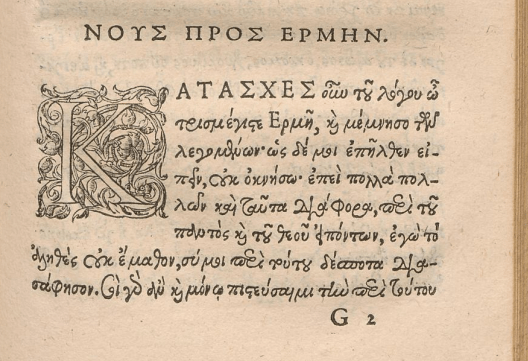
The Greeks, being the principal group that can even be considered a complex civilization offer their Hermeticism. As described in the Alexandrian Corpus Hermeticum, in the dialogues between Hermes Trismegistus and Tat, we see an emanationist and monistic system gathered around The One, or God as it is described in the Corpus. The early Hermetics were quick to recognize the limits of human knowledge and reason. Similarly, they describe a kind of henotheism-as being Hellenic polytheists, they were not keen to go against the cults of Apollo or Zeus. Instead they recognize the simple Divine or Spirit and they thus saw all myth as simple emanations of The One. Upon the arrival of Christianity, the early Church Fathers even saw Hermes Trismegistus as a sort of enlightened pagan who could foresee the emergence of Christianity and its monotheistic Abrahamic system. The reasoning for this particular Hermetic view of The One was quite remarkable, as it was based a somewhat purely abstract, almost dialectical inquiry. Simply put, all category fell into its opposite. By fall, it is meant that opposites were of the same substance (The One), and therefore they are categorically empty and things could only emanate within their particular opposites. Reality was thus the fall of The One into creation, after a moment of inequality within the One. Simplified: all that is invisible is visible and that which is visible makes the visible thereby invisible.
“You must understand how something that seems invisible to the multitude will become entirely visible to you. Actually, if it were not invisible, it would not always be. Everything seen has been begotten because at some point it came to be seen. But the invisible always is, and, because it always is, it does not need to be seen. Also, while remaining invisible because it always is, it makes all other things visible. The very entity that makes visibility does not make itself visible; what begets is not itself begotten; what presents the images of everything is not present to the imagination. For there is imagination only of things begotten. Coming is nothing but imagination.” -Corpus Hermeticum V
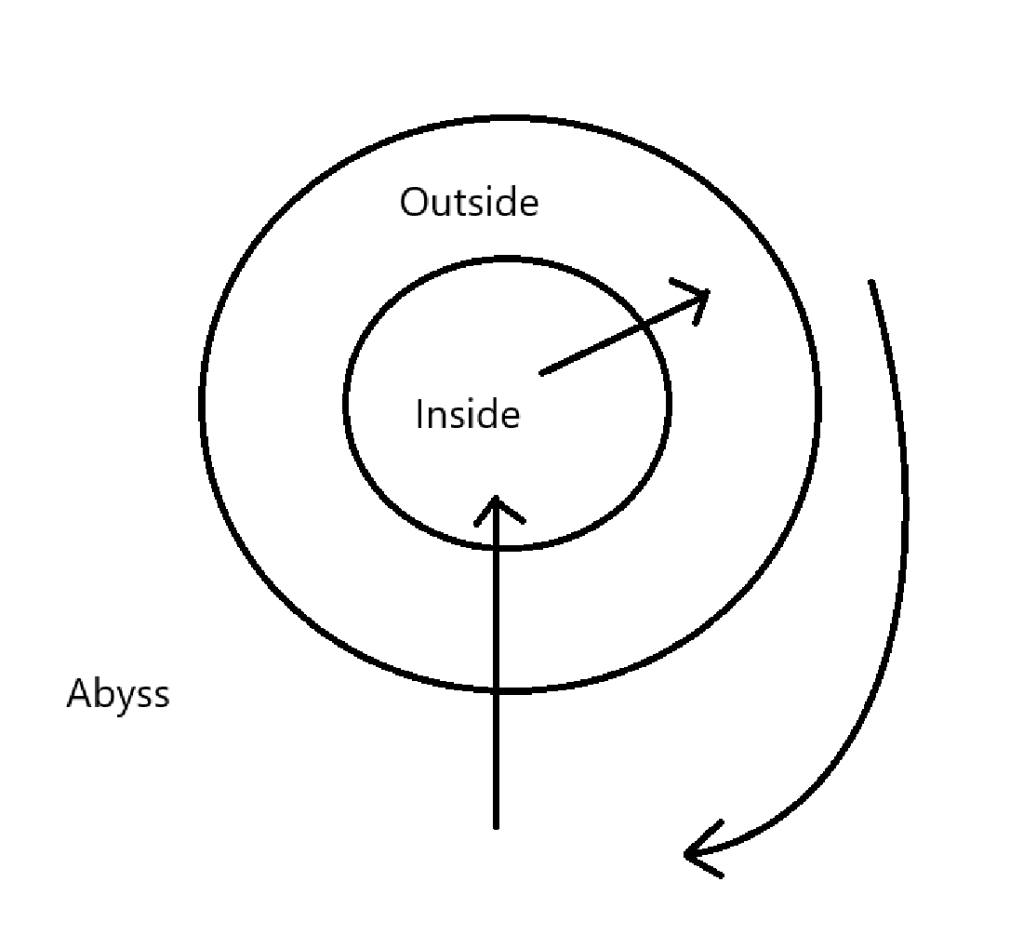
From this quote, we see the dialectic behind The One. It may seem that from this process, which itself could be eternal-we do not know the exact moment when it happened, that reality is inflexibly locked from us. We are put in the center, on the ground and above lays the invisible or Outside. We are therefore locked in a prison, sealed inside by celestial spheres of the planets, zodiac and finally outer Abyss. However, it would be fallacious to assume a fixed state of affairs or even, as the Corpus would state, to assume that anything simple lays as it is. After all, if we are to go about revealing the impossible or hidden, we evoke a new change when the sees new invisibles emerge as objects and things ultimately fall. The Hermetic quest is to therefore ally with the anomaly, to make the mundane anomalous.
With history unfolding, this notion developed. The Gnostics took the concept of a metaphysical prison and gave us the Demiurge. At the same time One God-Christianity preached its virtues of humbleness as humanity was the something which took the fall-right when Eve bit into the apple. A key reason for the suppression of the Gnostics as heretics in the Church Councils of the early fist millennium was that within the Old Testament, the omnipresent God (Yahweh) was still seen as the god in the New Testament. The Gnostics differentiated between the two as the evil restrictive description of demiurge or the fallen being and the One God. Furthermore, where mainstream Christianity at the time considered humanity as the principal thing which fell, the Demiurge in the Gnostic perspective made humanity fall, with it being cursed by physical bodies while at the same time possessing a kind of Divine Spark-one which cannot be perceived. We have here a dichotomy; once again we can say that the Gnostics and Hermetics are describing a prison, however would that really be possible? If humanity had indeed possessed a divine spark within them, then all category as it fell would be a change on a metaphysical scale. We can think back to the Corpus: Invisible makes visible and visible makes invisible. The Hermetic quest still stands within Gnosticism.
We reach a critical point when this exact problem of perception was formulated, that being the dialectic. Firstly, Kant divided the cosmos into the thing-in-itself and the thing-for-another. The thing-in-itself was the true state of a given thing. Upon perception, the thing-in-itself remained out of view; it could only be organized according specified sensibilities of space and time intuitionally. However most importantly, it was out of access. The most important implication of this is that the notion of time, and by extension, space as well could perhaps not be linear sequential orderings. Time would therefore be only a comparative tool of ordering, not an equalized state of being that extends across the cosmos. The thing-in-itself was therefore atemporal and non-spacial. If the thing-in-itself were indeed of this nature, that would mean that its effects would appear across several instances in time and space, making it a multiplicity of hidden, inaccessible phenomena. Phenomenologically, we can return to the Hermetic Cosmos, an ordering of spheres with the prison-world in the center, where the Outside comes Inside through complex entropic interactions of non-assembled spacial fluctuations. We can also put the time proposition into the arrangement, with the end result of the relapse onto Hegelian sublation and reconciliation in reference to negativity, being totally unmeasurable in which exact moment this relapse and alienation would happen.
It is hereby necessary to update our metaphysics. Going back to Hermeticism, and as mentioned before, the cosmic ordering which can seem an inflexible prison-world is in fact not a state of affairs, as it would seem according to Hermes Trismegistus, Kant and Hegel. Rather, it is a cybernetic, ship steering one. There are no objects or subjects, all is in fact one and thus there exist only actions. But what is the interaction of this One? If we take the simple cybernetic circuit-of fluctuations and recursive control mechanisms we can simply map out the Outside. However, we still do not know how this map would look like, given how unobservable the Outside is. One supporting hint at how the Outside comes in would be to analyze cybernetic control. Control is a simple dynamic process of the adaptation of a system to its environment through information and the communication of that collected information. If we apply the recursive cybernetic system to the cosmos, we see simply the same process as Hermes Trismegistus described: the invisible makes visible and thereby the visible makes invisible. Keeping to the cry of the Gnostics, it is critical to achieve this process as means to Aeonic change.
Cybernetics always had a syncretic and time-rebellious nature. In Norbert Wieners book on cybernetics: “Cybernetics or Control and Communication in the Animal and the Machine”. He openly states:
“In short, we are directed in time, and our relation to
the future is different from our relation to the past. All our questions are conditioned by this asymmetry, and all our answers to
these questions are equally conditioned by it.” -Newtonian and Bergsonian time
He uses a notable example, the human body. The Environment or in this case The Outside comes into the body. If we utilize the Nietzschean realization of the blurry boundaries of bodies, we seen channels of invasion that the Outside takes. The environment induces a systemic adaptation-as glucose come through the mouth and esophagus and is finally oxidized, the Outside is digested, made visible in a cosmic battle between the spheres of unknown and known and thereby entropy is reduced. We here see the immense realization. The cosmos, within cybernetic operations in higher metasystems is only whole, with time and space being the computational codes of the interplay and allocation of high and low entropic processes, formalized in the Outside coming in at moments which are then put into space through a complex process of signalectics. If humans do this with words, the cosmos does so with space.
This is where SpaceLang comes in, a language not bound by any linearity. It avoids words, but sticks to space. Linguistic primitives match with complex four dimensional polytopes. Semantics comes in, as syntax becomes a metaphorical balancing act of symmetry. As the hyper objects collide, relation begin to emerge immanently. Perspectives shift as informational capacity is upgraded to digest the metaphor fully. Time is broken completely, as info’s are distributed all in one go, which the human mouth can only dream about with its slimy tongue.
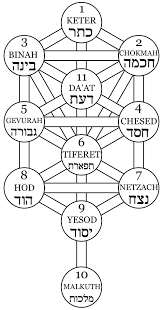
Since SpaceLang is the fundamental language of the Outside, it becomes a map of the cosmos, akin to the Kabbalistic Tree of Life. However, it rotates, shifts and reassembles based of invasion channels, akin to the Sephiroth. If we want to work with it, we can only use its shadow. Layed out into 2D paper, we see a complex kabbalistic system that maps out the thing-in-itself. Linguistics is therefore a warp drive, cybernetically communicating with the Outside as the kabbala-circuit becomes an anomaly or a sorcerer. Space and time can then be intruded upon. Warp-drives are signalectic systems or languages in the sense of informational conveyors.
Theia therefore came from the future, and collided with Earth due to a warp-drive mistake. The circuit of SpaceLang thus deposited across the Earth and AKS can now reverse engineer it. It can then become a cosmos truly for itself.
Continued: Intro to SpaceLang grammar, Published: 5109
Biblography:
Corpus Hemeticum
Critique of Pure Reason, Immanuel Kant, 1781
Cybernetics or Control and Communication in the Animal and the Machine, Norbert Weiner, 1948
 Hyperpsych