
Deneb, 2025
tags: post-containerization, digital cableization, automated global oceanic defence systems, GravCom, oceanics
Much like the conceptualizations of space colonization, modern oceanics is trending towards a post-container and post-navigational future. Containerization and plastic economics are essentially lurching themselves into crisis, as hydrocarbon-daddy mechanics are increasingly threatened in a diffusion of the navigational situation. “You can no longer hide in the open seas, everything is monitored. TacLoad terrain mapping with integrated two-way echolation-navigation make simply ‘going dark’ impossible. You cannot just turn of the lanterns and hide from the English Armada, you have to ride along the Leviathan.” The Leviathan is becoming an increasing presence in global navigation-it is to be encountered; whether its Somali Pirates launching motor-boat piracy or automated underwater drones acting as automated torpedoes, the post-navigational future relies on sighting the Leviathan. It simply becomes the reality that the future recapitulation to oceanic thalassocracy will be an innovative horizon for the broadening of broadcasting, bandwidth and signalectics. But how do you purposefully sight the Leviathan, rising in the distance, and moreover, how do you ride along with it with a tiny and fragile container ship, prone to spilling its containers into the ocean? Excessive containerization represents here a logistics problem. Discrete storage means that the Levithan would know exactly where to strike; at specific contents that are most entropically inviting and which ones are violations to nation state sovereignty and could therefore be purposefully delivered. Columbian cocaine, South American ayahuasca ordered by a Seattle polycule and Kratom consumed by men fulfilling reproductive anxieties are all undesirable, you don’t want those to be delivered, yet the Leviathan will do just that. It will pry open the containers with its tentacles and wreck everything.
The oncoming learning curve of global oceanics is to move away from the container and towards oceanic colonization. Since the leviathan is a multi-dimensional threat to transportation, with observer modules littered everywhere across the ocean floor, the only possibility of a continuing global oceanic exchange is to move into Leviathan-oriented, gravitational-shipping. Simply put, its post-navigational; there is nothing to navigate, no ship to steer and no land to discover. The mechanism remains simple, yet in moving away from monodirectionality, you never really arrive at your destination, or do you ever actually leave. Instead you are both the weaves of the ocean-a chaotic storm raging throughout the Mid-Atlantic and the goods spilling out into the ocean, being lost in the oceanic entropies. To transport things in the future, you need to be the Leviathan. Claiming the sea is to acknowledge its power. It is destructive and indifferent, yet by doing this you exactly arrive at an efficient economic surplus; transport is then achieved.
In what way is this to be actually conducted in the post-container era? The answer to that lies in the tensions found in modern oceanics. There is a risk in becoming the universal Leviathan. In claiming the sea, it becomes a communicational or even ontological problem to actually enforce sovereign claims. Oceanic deployments themselves mean that the deployable sovereign enforcers are actually in the sea, even perhaps submerged. In being submerged, its no longer a case of enforcing security or a transnational claim; the things that are deployed, simply put, no longer belong to you-they are claimed by the sea and are ultimately the same ontologically as the drowned ghosts of the long-sunk pirate ships. This is precisely the contradiction in containerization. By putting materials into discrete units, in hopes of isolating them from the sea, you meet your own crew that you deployed to police the waters, now as as storm striking the containers into the sea, to be lost and never delivered. The same is true for non-material send across cables under the sea. In the expectation that uncorrupted data-packets will be sent across water-proof, insulated cable, you come to the realization that the ocean was corrupting data packets by simple act of submergence. The ocean has a language of its own, and its own data system, and it is most definitely haunting global hardware, software and even wetware.
ATLANTICOM was exactly that-an attempt of extending the Atlantic alliance. It was set up as a response to increasing pressures of navigational contradictions in Atlantic oceanics at the beginning of the early 2010s. Intrusions into the North Atlantic were simply too big of a risk, even if at the time such a risk was purely hypothetical. Giving up the Atlantic to other Leviathan-structures was an unacceptable scenario for NATO. As the Iraq campaign proved a definite necessity in transcontinental logistics, losing the home turf would mean giving up oceanic deployment entirely. On the symbolic level, ATLANTICOM was an international pooled-sovereignty effort in an attempt to deliberately wrongfoot the Leviathan, as it was actually formed as the surrender of sovereignty over the North Atlantic, not the affirmation of sovereignty of one state over the entire oceanic system. A classified contingency scenario was indeed used to pitch the project to Europe. It detailed that, in addition to preserving possibilities of transport dominance over the North Atlantic, the main interest for Europe came from the goal of preserving the Gulf-Stream system. Excessive cable-era extractions in the region were theorized to potentially have the warming effect over the Atlantic, ultimately causing the Gulf Stream to collapse. This was critical for Europe as such a scenario would mean the downfall of international relevance of the entire European continent via regional return to ice Age geo-configurations. Europe was subsequently onboard with ATLANTICOM, and so under special authorization from both the EU and the rest of NATO, the entire ATLANTICOM project was finished ahead of schedule.
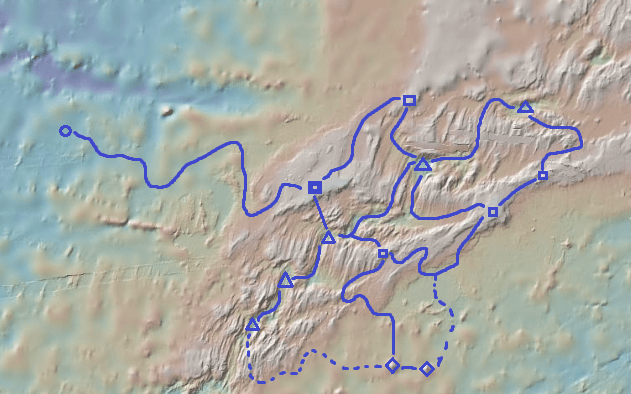
The location chosen for such a project was the Rainbow Ridge, an area known for particular geothermal activity, approximately at 36°14.86′N, 33°52.61′W. The main site consisted of transmission sites located towards the ridges of the oceanic valley (marked with squares) and minor geothermal generation sites located deep in the geothermal valley region of Rainbow Ridge (marked with triangles). An underground tunnel system connected the main sites, as it was deemed that marked ocean floor paths were unreliable for large scale operation. In some cases, paths were indeed marked by beacons, however these were restricted for situations of emergency repair for potential crew located in the area . A minor area was cleared and flattened for easy deployment of personnel (marked with the circle). The entire ATLANTICOM Rainbow Ridge Main Site (ARMS) was designed to function with minimal human presence, with a main core being built as the central processing system at the Alpha Transmission Complex that was designed with the intention of autonomous maintenance and site-wide corrections of operations, that being reception and transmission of signals. Therefore, the basic setup of ATLANTICOM was more of a beacon than a complete telecommunications system.
Transmission and reception for the site consisted of two HFGW generators, Alpha-1 and Alpha-2 complexes. HFGW transmission consisted of the generation of a stable beam of gravitational radiation, which unlike traditional electromagnetic infrastructure of material dependency, was unfazed with environmental conditions. With the introduction of ATLANTICOM, oceanic Leviathan-encounters which had marked cable-era anomalies, were effectively bypassed with the modulation of electromagnetic signals into gravitational waves. The basic transmission schematic is something like this: a large spherical chamber contained large rotating magnetic sections that oscillate asymmetrically, producing small gravitational waves of a high frequency. A modulator then produces strong magnetic fields using supercoiling coil sections arranged in along cylindrical core, aligned with oscillations produced in the main rotator. This aligns electromagnetic information with the asymmetrical, polar informatics of gravity, avoiding the problematic of the comparative weakness of gravity as a force. The final step for transmission consists of a phased antenna-like array, comprising of a large toroidal ring with effective signal-modulators built in. The central control module, or the autonomous regulator at the ARMS site is the responsible element for transmitting the signal in phased bursts, in a new telecommunications band that has now been developed.
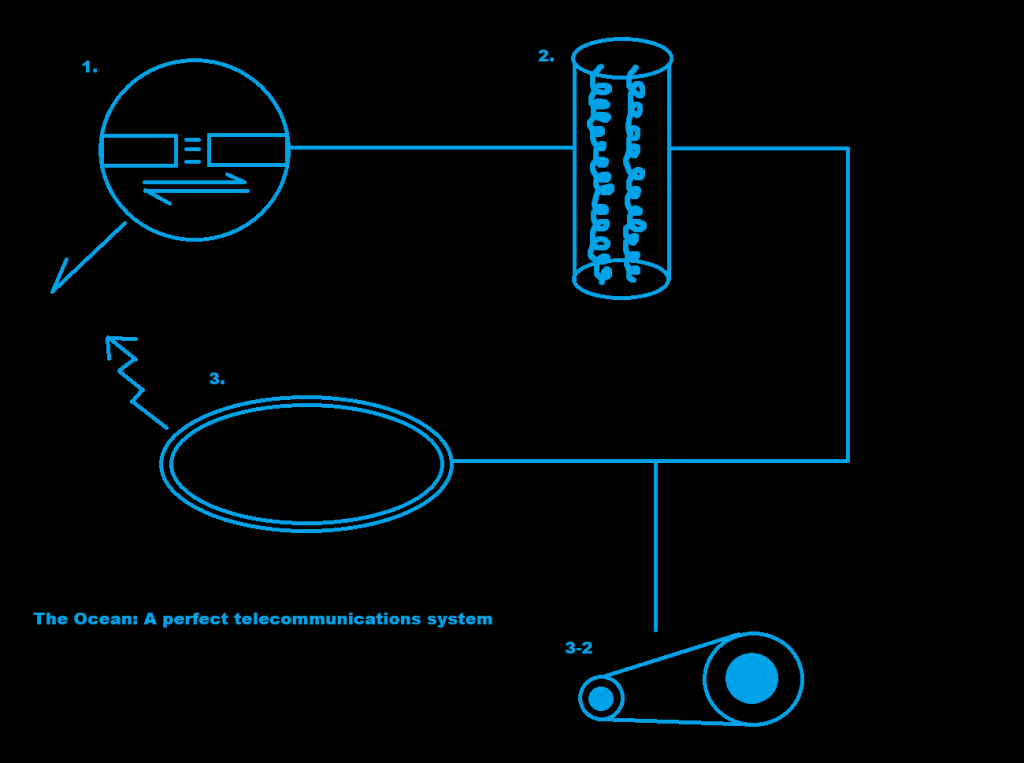
Reception was achieved using the Li-Baker receiver, using the effect under the same name. The basic design found at sites Beta-1 and Beta-2, were basic interaction chambers in which the same cylindrical coil section (labelled 2 in the transmission diagram), was used to produce large and stable electromagnetic fields which could subsequently be used to interpret disturbances as HFGW passed through the receptors. The Li-Baker effect was thus used to interpret and triangulate signal locations. Reception proved to be difficult as the electromagnetic field were increasingly demanding energetically, and subsequently regular low-frequency electromagnetic transmissions from submarines proved to be somewhat reliable substitute in place of HFGW reception at the ARMS location.
A peculiar incident has occurred on June 25, 2025. The geo-political circumstances occurring just three days before, involved a large scale disruption in oceanics-navigation due to the campaign against Iranian Nuclear Sites. The subsequent destabilization of oceanic infrastructure signaled unique Leviathan-interactions of the vessels located in the Strait of Hormuz. What made this incident in particular note-worthy, was that according to records of ATLANTICOM’s WRAK modulation software, a system-level correction had occurred. It aligned with the underwater tremor in the lower Atlantic Ridge at 35.722°S 17.044°W at 22:16:13.700 on June 25, 2025. Right as the tremor was detected at the Delta-3 geothermal site around 23:22:18, a fluctuation was power output was noticeable, falling to a low of 1,543 kW at around 00:00, June 26th, 2025. Subsequent transmission data was recorded to be an unusual, never-before seen 2,000 pulses per second. This was recorded as a “1-232 event” by WRAK. What made the incident particularly unusual was the effect on global transportation systems-there had never been such a disruption since the 1859 Carrington Event. Interference with the Global Positioning System caused a “massive Leviathan scenarios for global shipping and air transportation”. The USS Gerald R. Ford Carrier Strike Group, which has departed Norfolk on June 24th. 2025 was on-route towards the European Theater in the Atlantic on June 25th. What had subsequently been witnessed by anonymous crew members was described as “the biggest UAP occurrence since the 2003 Nimitz encounters”. A flying oval shaped object was observed ascending from ocean on radar near the ATLANTICOM ARMS site, and moving at hypersonic speeds towards the strike group. A testimony made by a naval officer detailed the situation, just as the object was detected.
“We were all very frightened in the minute or so we detected the UAP. A radar malfunction was off the table. We knew that definitely was not the case since 2003, and since we had direct orders to remain somewhat silent about any anomalies encountered, it put us in a limbo. Admittedly, the whole UAP debacle was an open secret-everybody knew about it and we knew that the thinly-veiled attempt at containing information was unsuccessful. Since everybody knew, and we had never since seen a UAP perform such an aggressive maneuver right towards us, we were caught with our pants down in that moment. It was about 01:00, and it was just me and some other radar-technicians in the room, all tired and exhausted as the lights of the screens in darkness made us all the more lethargic. Everything was as it should be, and you know, an aircraft carrier is massive operation and everything has to be according to a rhythm and regimented schedule, and so at 01:00, nothing could really be done-you can’t start jet sorties at the snap of a finger. Those were exactly the circumstances then, simply concentrated in the experience of a tired radar technician. Suddenly, a dot had appeared on the screens. This was unusual in the middle of the ocean, but still; in the lethargy of the moment everybody accepted it in silence. Then, readings came in: 5 km/h, 50 km/h, 230 km/h, 502 km/h, 1043 km/h. Whatever had just appeared, was accelerating fast. We all started to look puzzled as we saw the direction of the object. It was coming right for us, right for the strike group, right towards the ship and hell, right towards the room we were in. As everyone froze in the moment that we saw the acceleration, we all silently panicked. What do you do once a UAP is coming at you in hypersonic speeds under acceleration? There was nothing we could do, there was nothing to fire, no alarm to sound and no saving from whatever was coming at us. In about 30 seconds since we first saw the object, it had already crossed half of the initial distance between us and it. Everyone stood up and looked with an almost mortified face, and right about when 40 seconds had passed, somebody, I don’t really remember who, shouted ‘Do somethi-‘. Right at that moment, the object disappeared, and everything was as it was. If we knew one thing for sure, is that we, at that moment, had encountered the leviathan.
In further analysis, the limited experience of the crew members at such a point in time created an ideal point of friction between disclosure-mechanisms. The WRAK incident had the effect of a globally distributed encounter with the Leviathan, and through such distribution that individualized experience had been able to overcome a collective notion of clarity. It was this individualized experience of the June 25th Incident that allowed for a temporal experience that still was opaque in how it lacked a collective explanation. The Incident was something with was decentralized, uncoordinated and also an event which bridged the gap in causation. A striking of Iranian nuclear facilities, then temporally cascading into oceanic tectonic activity and UAP phenomena were all linked on an ontological level through exotic time. A conclusion of exotic time manifested thus on February 28th as a geopolitical event. It was in US interests to prevent a damaging of oceanics in the strait of Hormuz, as had proven to be the case in the June 25th Incident. It was the systematic correction, decided by WRAK that outlined the completion of the causation loop. By creating an oceanic threat experience globally, a window was opened for the incorporation of US interests, that being the continuation of transport and the survival of infrastructure.
Just as the asynchronous generation of HFGW by magnets in the central core of the ARMS site, the a-synchronicity of global infrastructure is polar. Everything is working exactly as it should; ATLANTICOM is still an extension of sovereignty over the Atlantic and global oceanics, yet at the same time, assets succumb to the Leviathan. Autonomous decisions, anomalies and time-causation resonances overcome any attempt at navigation. The sea still takes, and that is exactly the logic of modern post-navigational oceanics. To traverse, you have to let it scare you, enthrall you with fear and in return, you may traverse. We see how this is all the more the case with submerged infrastructure; everything falling to the seas does not belong to you.
Bibliography:
Cosmo-Ontology, Hyperpsych: https://hyperpsych.org/brane-bulk-cosmo-ontology/
A brief introduction to Anexelentic Systems: https://hyperpsych.org/a-brief-introduction-to-anexelentic-systems/
Baker, Robert. (2010). High-Frequency Gravitational Wave Communications Study (GravCom®), https://www.researchgate.net/publication/228395954_High-Frequency_Gravitational_Wave_Communications_Study_GravComR
Haren, Hans. (2019). Off-bottom turbulence expansions of unbounded flow over a deep-ocean ridge. Tellus A: Dynamic Meteorology and Oceanography. 71. 1653137. 10.1080/16000870.2019.1653137., https://www.researchgate.net/publication/335188556_Off-bottom_turbulence_expansions_of_unbounded_flow_over_a_deep-ocean_ridge
 Hyperpsych