
Arcturus, 2025
Parasitic Poetics is a term used to describe the cryptological position of poetry as the universal that comes to encapsulate differentiation itself, or in other words, the procedural parasitic orientation of poetry with its thematic content. In being parasitic, poetics come to occupy the unique property of modulating amplification of where the intentional authorial choices begin and end. Parasitic representation orients itself towards the image of the landscape in its continuity; the way the fields come to bounce in gentle hills is made the poetic feedstock, the food for which the poem sustains itself. The grasping of the poetic image and its spatial-temporal arrangement, that being for instance, how golden grain grasps and grows and in soil rows, causes the reduction of the internal tensions of the reader. This causes an unusual effect, as in the reader may lay charged libidinal currents, for which basic aesthetic desire is formed for the poetic imagery, but they are actually reduced aesthetically into simple formations of time and space itself; there is no continuous resuscitation of the poetic landscape, but rather the discontinuous denaturing of the libidinal energy into distinct parts and components. It is this effect that marks the very parasitism of parasitic poetics, as in feeding on authorial technique and meter, the poem induces a recursion onto the reader; it grows the semantic relation for which may be taken for granted as symbolically laying in language, whereas they themselves, that being the linguistic-logical assemblage that the reader is accustomed to, is actually made poetic itself. The desire for poetry thus is made as the true feedstock for the poem. No longer is ambiguity made to come from simply the semantic meaning of concrete units of words, and the encounters with synonymity, rather ambiguity is made induced inside the subject-reader, as imagery is imprinted in libidinal divisions that make the depicted image transform into the reader. We can thus clearly see that this is utmost parasitic; the consumption of libidinally erotic desire is horrific as well, like an unknown creature simply feeding mimetically on the subject, outside of the confines of the poem. Through this exact escaping, presents the inverse of the phenomenon that we had just described. The semantic determinacy of the poem begins to fall to lower levels, making ambiguity grow rife. Words are no longer word-images, merely pointing something out, but are syncretic logico-numerical units that display simple recursion, repetition and procedural variation. Parasitic representations are polar, as they come to encompass the effects on both parties, in one go, rather than continuously. We could thus assume that they are representations of genealogy, but this would be incorrect, as the parasitic semantic units are innately oriented towards a singularity which arrives in specific moments. We can see this in the matrix-poem.
The matrix poem consists most basically of a meter-key. The meter-key is made of two axises, x and y, if one desires to represent two dimensionally. On both axises, numbers can placed accordingly to the intentions of providing meter to the poetic expression. Numbered Iambs (1,2,3, etc.) are thus produced by the intersection of two numbered moments on both axises. Therefore, the meter key resembles a Cartesian Plane, however the numbers are not concrete in their points, as would be the case for usual Cartesian points such as (1,3) or (0,1). Rather they are gradients in which a zone is made to correspond to a singular numerical unit. This makes the matrix poem a sequence of shapes, rather than words. These gradients thus make for the parasitism in representation, as they invites ambiguity in the logical processing system. Gradient truth statements therefore replace ordinate continuous states found in usual poetic arrangements and cause the possibility of a multiplicity in semantics, making meaning a process of schizogony, rather than determination. Schizogony here means that the amplification of presence in the subject induces the discontinuous causal change in the reduction of the poetic element, as it is expanded in its finality, and thus encompasses the reader-subject. The scale of the zones makes for the poetic meter, as it can determine the positions of the iambs. A logarithmic base-10 meter makes for the most compelling, as it invites the shift of the x and y axis. As for instance, if one wanted to make a basic unit of the numerical designation of 4, then there could be three potential representations, and based on the combination of x and y gradients, the shape could either be stretched or compressed on both axises, by virtue of the increasing logarithmic gradients on the meter-key. A basic log base 10 meter key would look as the following:
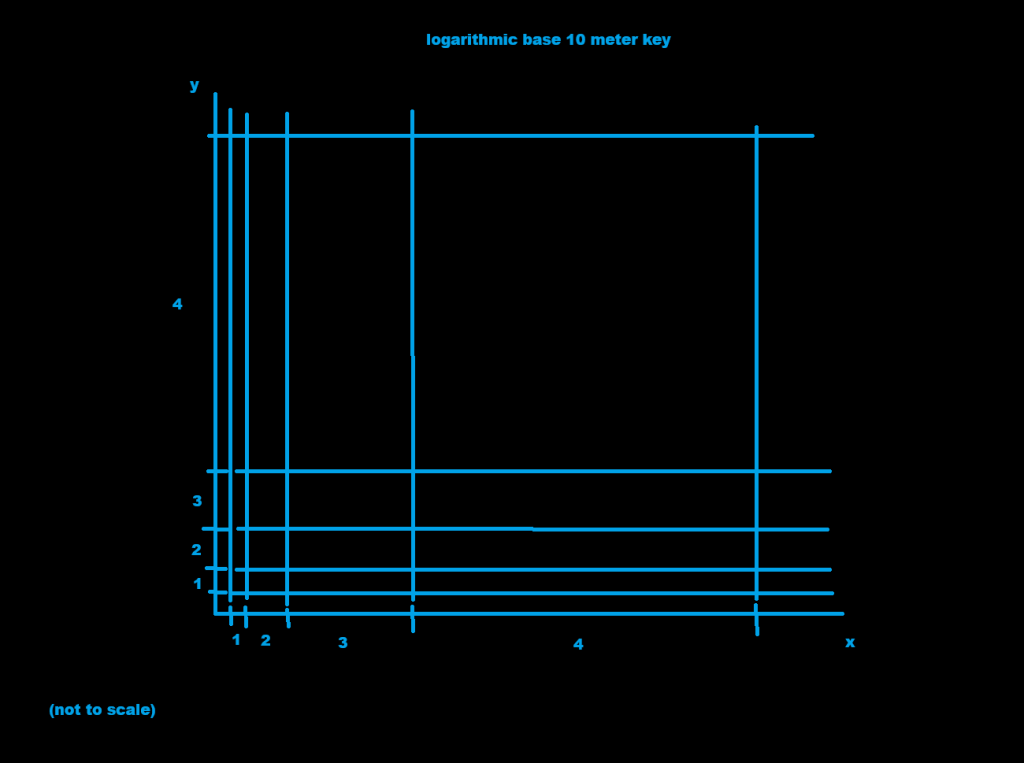
The x and y axises are representative of space and time respectively. Within both space and time, they are in their most basic form, that of an increasing counting towards infinity. This basic possibility of combination and summation forms the backbone of the matrix poem. For instance, on a basic level, if it were desired to represent the number 5 as a basic unit, it could be done in multiple ways. One way is to look at 3 on the x axis and to then take 2 on the y. The shape is thus the enclosed zone which is formed by (3,2). In the example meter-key, that would appear as a roughly proportional rectangle. However, it can also be represented by taking 4 on the x axis and 1 on the y (4,1), giving a more stretched form of a rectangle along the y axis. This summation operation gives rise to poetic forms themselves; on the spatial x axis a value of 4 and a temporal value of 1 could have the poetic intention of localized fragmentation. The experience is for example, made relevant to the properties of the individual things in the content; smells and sounds replace description of the whole objects. Inversely, a similar temporal and spatial value could signify the stability of the whole; the object would be represented in the complete metaphor, without alliteration of phonetic sounds as in the stretched unit forms.
Parasitism therefore signifies the discontinuous amplification of one element, that being time or space, and the induction of reduction in the other. The intersections of these elements in strings of numerical values representing poetic experience, cause the recursive generation of novel poetic expressions. Through schizogony, phonetics and linguistical-logical systems collide to form a dynamic engine of poetic enrichment as being aestheticized in respect to the universals present. It is no longer the case that the universal is differentiation itself, rather that the aesthetic identities formed by rhythmic recursion, repetition, individuation are universal in the regard that they resonate with the other units in being the dynamic and parasitic in their perception by the reader. The base 10 meter allows for most conceptual differentiation as an evolving dynamic process, while still offering a linear stability which permeates the entire poetic structure as the continuous element of procedural progression, and learning. This line of stability being the asymptote formed by a simple logarithmic equation . What appears as yet another effect of parasitism is the unity in which both space and time are presented, as even though the existence of a stable zone does not out run the discontinuous and poetically novel elements. It is the case that the limit is libidinality, which unifies how parasitism modifies the polarity of the poem. A relapse into unifying metaphor is possible, however that metaphor is never fully captured by any of the respective zones; it is distributed as a lingering element or as a parasite upon the whole of the poem (and in turn, the reader), making it transmissible and formable into a substance whose form is only known insofar time and space precede its internal identity. This is what gives ambiguity and orients the logical system towards singularities that unify, and subsequently deconstruct the poem itself.
Bibliography:
Hyperpsych, Brane-Bulk Cosmo-ontology: https://hyperpsych.org/brane-bulk-cosmo-ontology/
 Hyperpsych