
Arcturus, 2023
tags: brane cosmology, becoming, thanatolatry, thantos-engine, cosmo-ontology, post-phenomoneology
Introduction
It has become somewhat of a necessity to develop a new methodology of ontology, one which account for the fullness of the exotic conditions found in the Universe. Concretely, one which is unconfined to a closed system or a process which can be taken as the totality of the All. The All, must therefore, be truly the All. This assertion may seem as a rather arbitrary or even abstract condition which has been raised pre-maturely, and this would be partially right; for it is a currently empty assertion as it stands. However, the overall course of Continental Philosophy as whole, generally, has been founded on the recursivity in conclusion onto the tradition of German Idealism-onto the thing-itself of Kant and on the dialectic of Hegel. Such a positioning of not only ontology, but political, ethical and social philosophy only reaffirms genealogy, while failing to respond fully to the modern condition. We are asserting therefore that overall, the basic modern necessity of a movement forwards in terms of philosophical innovation must not return to a finitude, that being either the abstract thing-in-itself or the closed final Negation into the Absolute. We must, in a way, “own up” the processes of the Things that we find in the Universe, and to thereby avoid a new philosophical dark age, analogous to the actual Dark Ages, with a drought of philosophical concepts and dry inertness. To reject a new Obscurantism founded on the prescribed concepts of an impossible full access to the Universe is thus a necessary pre-condition to the fullest harmony of understanding Being.
The concept of this new movement is therefore the area of Cosmo-Ontology, or the phenomenology of the Cosmos, the strange and the inhuman. Cosmo-Ontology must crucially operate on the following basic and primordial principles, so as to avoid becoming a simple genealogical recursion: (1) It must, in its most basic forms, take ontology as something which is inside the All, or the Universe. Ontology and metaphysics must not be replaced therefore, with problematics of epistemology. (2) Cosmo-Ontology must firstly base itself phenomenology and the sensuous experience of agents, regardless of whether they are human. (3) Historicity and the historical condition are to be taken as inside the object of its observation-the Cosmos or the All, and not as the total sum of techno-economic development. Therefore, keeping those principles in mind, Cosmo-ontology shall be analysed in the following structure: (1) Sensuousness: basic Perception (2) Perception-towards-Being (3) Univocal Linguistics as the primordial form of the Universal (4) Essence as the state-of-Aesthetics and Aesthetic Thinghood (5) Time and Space as the projection of Distance (6) The There: Potentiality as the prerequisite of the Actual (7) Certainty with regards to the There: the Brane (8) Uncertain-There: the Bulk (9) Dimensionality and the Process of the Paradox (10) Death and the Thanatos-Engine: Thanatolatry. In that order, Cosmo-ontology shall be analysed.
Sensuousness: basic Perception
We thereby open ourselves to the starting point of our analysis: basic Perception and Sensuousness. In the most primordial form, that is, in the immediacy of the moments of which we can allow ourselves to perceive, we are confronted with the immanent harmony of the World. It would seem as that the World, the collective total experience naturally follows the order by which we strive to be. At the farm, the farmer naturally tends to his farm, and in the city, people reside and live. The thing that is the farm, is firstly perceived with the assertion that is has existed and will exist in the immediacy by which we encounter it. The possibility of an encounter with the impossible, or in other words, an encounter with that which lies outside of our most basic senses of experience seems almost impossible on its own account. It is therefore the case that Basic Perception, or the most simple acts of unintentional noticing of the World, is innately interested in the Things that it is oriented towards, and in the case of everyday banality, that happens to be Lived Experience. Lived Experience, by virtue of its first most orientation towards the Past, knows what the Thing is. To do that, it dwells in the Temporal Past, seeking out what has happened as a way to be the already-before Perception itself. What we see therefore is that Lived Experience in Perception, reflects itself from the past and is directly inside the present; it is actively the means of which we come know primordially, or before full Perception. Intuitively, it is the case that we recognize a Thing from its surface, smell, sight and sound. Lived Experience is therefore the means by which the World is organized into immediacy and what is actually the most pre-cognitive form of knowing. From this primordial form, is also basic Consciousness, which is the passive element of organizing the immediacy of Perception. Basic Perception however, never knows the immediacy fully, given that Lived Experience is the reflection of the the past into the present and therefore, new Things are unknown.
It is precisely these new Things that reveal the full scale of immediacy-that in actuality it is the case that the immediacy which we experience is the already-there at the hand of our Consciousness or in subjective terms, the I. If in the case of the Perceiving of the farmer’s farm, we come to know his field; that it is gold in color, then that experience of Immediacy is only in the side of Consciousness. Lived Experience is in that sense, the disembodied form that Perceives-for-us, without us putting in much struggle. It is in the immediacy and in the World, and is the direct entanglement of the past with the present. In a way, Lived Experience is not a an actual medium for-Consciousness, but rather a mode which gives the pre-Perceived experience to Consciousness, at the request of Consciousness. If that is indeed the case, then it is increasingly visible that the immediacy of the farmer’s field, or in other words, his plane of immediacy, is essentially the reflection of Consciousness onto itself via Lived Experience reflecting the temporal past onto the most present now. Basic Perception therefore, is directly approached with an attitude of Certainty. Certainty is the mode by which Basic Perception allows us to Perceive the plane of immediacy. We come to know, Now, that this plane is rather flat, as the Lived Experience of our subject consumes the present Now and makes into the pre-made experience of intuitive sensing.
We have at hand here two main points needing developing. Firstly, Lived Experience, as a definite entity within the world is positioned in such a way that makes it questionable if indeed, it is actually of-Consciousness. This is importantly distinguished from it being in-service-to, or that it is under the direct influencing of Consciousness and vice versa, that it is influenced by Consciousness. Thus the preliminary problematic is that Lived Experience may not be made-of Consciousness essentially. Such a case may be evidenced by the simple progression of the temporal, given that, as we have referenced earlier, new Things coming into an immediacy is something which assails or possess the I, and is not the act of the Lived Experience directly, as Lived Experience is the simple reflection of past into present. Lived Experience has the essence of being-for-the-past, or more concretely, is in the term “to be”, in so far as it is only in the past or is oriented towards the past transparently. For it to be transparent, that is reflective toward the criterion of being true, it must stay in its essence. Its essence thus cannot be the other to being-for-the-past and it importantly cannot cross into the future, at least within the everydayness of the banal and Basic Perception. Therefore, the fact that Consciousness is “possessed” by something which is other-to-itself in the experience of becoming certain of the uncertain, that asserts that Lived Experience is not of the same essence as the Consciousness of the I. In the psychoanalytic perspective, this may hence be signified as the realm of the unconscious. If Lived Experience has another essence, that may even suggest that it is in its whole another Entity, however for that to be fully answered we will have to develop other analytics to dully answer that question.
Secondly, in regards to Certainty, it must be shortly explained that it is, somewhat paradoxically, not of the Conscious essence either. Being-Certain is the mode that which Perception takes once Lived Experience provides the preliminary ground, via the past. It is never affirmed by either the past, present or future, rather it is the most direct affirmed by the simple expression “to be”. That means that, in regards to what it essentially is the orientation of itself towards being directly, it contains the essence of Being-There, as in it is in the immediacy of itself, that is the totality of primordial Basic Perception. If the essential constitution of Certainty is in fact its orientation towards immediacy, that then suggests that it itself affirms temporality, when it influences Consciousness is such a way that it predicts the near-future or outlines the near -past. Thus Certainty cannot in a way be replaced by Lived Experience, for Lived Experience affirms the existential relation of the I to its history and genealogy, via the essential relation of Lived Experience to the temporal past.
The remaining question therefore, is to actually detail what happens in Basic Perception, how it comes to be the most primordial form of knowing and what can potentially happen after Basic Perception concludes. This is therefore, the full process of Basic Perception. In the encounter with a given Thing, which we may for the case of demonstration to be a vase atop a small table, immediacy is first confronted in the most primordial form. The combined full Thing that is both the vase and the table, is thus Perceived in the most minute moments of the Now. As the Now begins to flee further and further into the Future, thereby becoming what was, Lived Experience senses this and begins to take action. Immediately, the past is entangled and brought to the most present Now, and it begins to take hold, making the timeline appear oblique-the most distant past now links directly to the most present Now and the near past is fully in the Now. The I or Consciousness has come to Perceive the first immediacy of what is, and it is now where Certainty takes hold of the entire being; what Consciousness is oriented towards; the table naturally is ought to hold up the vase, as that is the most current Unity which fulfils the essence of the vase-it is for-the-vase. It is precisely this which completes the process of Basic Perception. The unfolding of Basic Perception is constituted by the three-fold process of interaction between Lived Experience, Certainty and Consciousness itself.
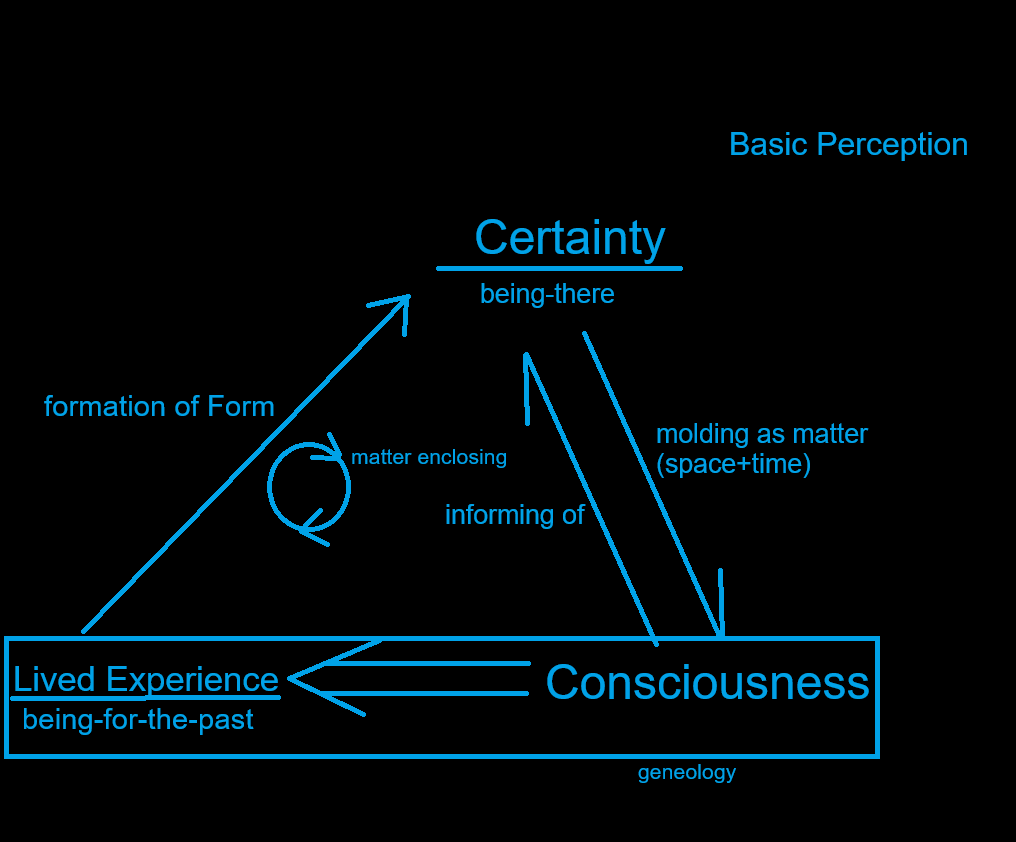
However, we must naturally consider the new Things, as that is precisely when the Certainty in the state of affairs fails to fully orient itself in its essence as toward-being in what is immediate. That which cannot be smoothly Certain is precisely the engine by which Basic Perception augments itself into Perception where Consciousness is fully at the helm of Perception; it is oriented towards-being. In such Perception, Certainty has fallen into Uncertainty and Lived Experience cannot fully close the gap between affirming the immediacy and Consciousness. The Conscious I must now bring itself into the active role of Perception.
Perception-Towards-Being
Thus, Consciousness must now account for its own perception. Certainty is no longer sufficient for giving insight into what is immediate; it now becomes a question of how and in what way Consciousness can locate itself in the new realm of Uncertainty. Uncertainty, therefore, is the direct absence of the Certainty of primordial Perception. In moments that solicit the new things, that being Things whose essence lies together with the temporal future, it appears that the most primary ways in which Uncertainty manifests is in the forms of what is new. The form of Lived Experience, in comparison, is that of the Conscious I; it reflects and affirms Consciousness in such a manner of existential verification, precisely by by the formation of a form for-Consciousness. As we have previously analyzed, the for-Conscious essence of Lived Experience grants it access to-Consciousness and to the historicity of experiences once recorded. Through this very process, Lived Experience gives a form; one which is self-identical to Consciousness, no matter how essentially or substantially, it is not of-Consciousness. In the moment of primordial immediacy, the formation of the Conscious form was that of the joining of two temporal ends, that being the distant most past end and one of the immediate Now. This lends a a most basic form-that of a circle, which can be Perceived by the others who posses Lived Experience as well; their Lived Experience comes to know the particularly sensed Other-Consciousness, through the self-reflection of themselves into Other via Certainty. If Consciousness under the effects of Certainty, dwelling in immediacy, has the form of a circular Lived Experience, then the question naturally comes: What form does Uncertainty take?
To answer that question, we must bring ourselves to the short analysis of the reflection of Certainty, so as to arrive to the form of Uncertainty. In the previous section, we had come to realize that the ultimate resultative manifestation of basic Perception is the reflection and recognition of Consciousness in the immediate space; it was that Consciousness was reflected into its ancestrally, via essence. Therefore, the question of Uncertainty dwells firstly on the assertion that Uncertainty posses the essence of being distinct form Consciousness. That notion brings us to the possibility that Uncertainty posses no form at all, after all if, in the essential realm, absolute difference reigns as the ultimate between Certainty and Uncertainty, then instead of taking the form of Circle, Uncertainty is no form at all. Such a notion however, quickly brings a problematic. If Uncertainty were to simply be no-Thing, that would imply that, even in the most minor moments of movement away from Certain Basic-Perception, the entire schematic of Conscious Experience would collapse into the darkness of Uncertainty; no-Thing would be and the two beings would annihilate each other. Incidentally, since Uncertainty in this case would be simple nothingness, it would come victorious over Certainty. In that conceptualization of Uncertainty, it comes to be that any kind of movement and change would result in the sudden death of Consciousness. The force attaining Uncertainty would simply be too great and would raze apart any notions of Conscious continuity. However, there is one aspect which is critical in evaluating Uncertainty, and one which we have missed. In the assumption that Uncertainty posses no form, we have unknowingly placed Consciousness into the essential relation being-for-Now, or being in the most immediate moment to be torn apart by Uncertainty. Thus, it becomes clear that if Consciousness were to posses such an essence, there would be no Consciousness in the first place. We have stated the form of Consciousness is formed through the joining of moments, and critically the joining of Now and Before by Lived Experience. It is thus simply untrue that Consciousness posses that essence, since it is self-reflecting-it is continuous by its recognition of itself in the area in which it dwells. The conceptualization of Uncertainty as absolute and ultimate in being-for-itself, or being-for-nothing is therefore erroneous and it is the case that Uncertainty is already reflected in the form of Consciousness.
If we were to take the most Uncertain Thing for Consciousness, that being the Conscious Other, then the picture becomes much clearer. For example, a person is meeting a stranger; a being that is fully Conscious and posses Certainty too, just as our singular Conscious person. In the moment of Basic Perception, the Other already comes with a form-that is of a human, of a man. It is the case therefore, that the form of what comes into immediacy as new, or as ascertaining an being of Uncertainty, Consciousness captures its Uncertainty as that which is can be reflected in itself. Uncertain form thus is not the man killing the other, but rather in the interdepended of both to each other. Pleasant conversation is the means by which any Uncertainty is pointed at-it is taken note of by the Other and the Other’s Consciousness assumes the essence of being-towards-uncertainty. That is thus the most primordial form which Uncertainty takes. It is not the case therefore that Consciousness is torn apart by formlessness in Uncertainty, rather that Consciousness owns up to the death of its previous. In such a situation, the absence of Certainty and hence Lived Experience does not expose a passive Conscious core incapable of owning up to itself. Rather, it is that Consciousness reckons and calculates, and welcomes the moment of Uncertainty by positioning itself as a new form that is temporarily in being itself, with the essence of being-in-being. Just as a snail finding a new home, this leaves behind a shell of Certainty and Lived Experience. Consciousness can, however, still come to posses a Certainty and Lived Experience. The process follows the modulation of the Conscious form, via a re-activation of Lived Experience making a new shell of Certainty over the dislocated Consciousness. In such a process, the essence of Consciousness is retreated into itself. Therefore, to add on to our circular form of Certain Consciousness, we can imagine Uncertainty as the modulation of the Circle; making it big, then small, then wide, all while acting on Consciousness as a mold, which can then become the new solidified form of a new Consciousness.
We have thus formulated that the form of Uncertainty is the direct of orientation of Consciousness into a Perception-towards-being. In such Perception, Uncertainty is neither the direct Other, nor a formless disturbance of Certainty. Rather it is the movement of Consciousness through being itself, where it achieves an essence that reflects the Uncertainty; it finds itself as time moves forward and associates with novelty. Therefore, Uncertainty is the engine by which Consciousness can form a new surface of recording and a new Lived Experience. What holds from this as well, is the paradoxical realization that even in Basic Perception, Uncertainty was already there, and it was the element by which even the most primordial functions of Perceptions were formulated. This precisely gives us the situation by which Uncertainty acts upon Consciousness; as the essentially matched transition between Consciousness in the Uncertain moment and the potentiality of a given situation, is precisely the form of Uncertainty itself. Here we definitively come to reject the erroneous designation of Uncertainty, for it is the surrounding potentiality of encounter, with an essence of being-for-being that finds moments of intrusion into Consciousness, right when Consciousness assumes the essence and form. This is the prerequisite for the moment of movement, as Consciousness must reflect to some extent in Uncertainty for there to be a productive encounter, and in case of total essential separation and unreflectivity, the two beings would never come into contact. In moments of these encounters, the persistence of Consciousness points to a deeper and more complex structure; that of a plane Certainty, which is surrounded by plane of Uncertainty, whose most direct observable property is the movement of the subject in thought and space. These planes are composed substantially of space and time themselves, as their are the enclosed shapes of compressed spatiotemporally giving a form. However, the analysis of the planes must first warrant an exploration of the most direct interaction of Certain and Uncertain, that being in the linguistic forms of Perception and the recording of ancestrality. The analysis will point to a more concrete conceptualization of the moments of Conscious transition, and shall therefore give us a clearer view of the mechanisms at play.
Univocal Linguistics as the primordial form of the Universal
The realm in which the interactions of Certainty and Uncertainty are most visible in none other than that of language. This happens to be so since language is the medium of representing phenomenological informatics, or resonances of given Things in their movements. Therefore, an analysis of language seems most warranted, since if language were to stay a neutral element in our schematics, inert epistemologies would quickly appear. It is precisely this reappearance of the problematic of the Real which would sever the unities of being and ontological systematics, as we would take the most extending factualities of the present moment and project them across the entirety of temporality and spatiality. Language would be the most active front of this potential conflict between the supposed Real and the process of given becomings.
What we preemptively define as the concrete problematic of this section is the simple persistence of Consciousness, despite the forces that it comes under. We have seen that despite Uncertainty, Consciousness appears as stable and ready to persist. It is thus a question of how, and by what mechanic Consciousness tames forces that appear hostile. For that to concisely be articulated we need to build it up procedurally, so as to keep in mind our previous analysis and to avoid making an contradictive error.
In the encounter of Consciousness with the moment of transition, or Uncertainty in its metastability, we had come to know that Lived Experience is the entity by which the form of Consciousness is realized; it informs Consciousness and gives form, by compressing it into Certainty. Thus the preliminary observation is that Consciousness lies in the material, and that it is something which is acted upon-by forces at the hands of Certainty and Lived Experience. The presence of both is indicative of a recorded process; exactly when and how is preserved exactly in Lived Experience, by its role of genealogy. If a genealogy were to be made by Lived Experience, then for Consciousness, it would be impossible to know how its origin came to be, and as we have outlined previously, it may even be confirmed by the fact that Lived Experience inherently rounds up the timeline corresponding relatively in the past. The origin of Consciousness, would be impossible to access if Consciousness were to seek a genealogy of itself at the moment of genesis-Lived Experience would would make the present moment the moment of assuredly being-existing Now and the most present would be affirmed to be exactly the same, with precisely no difference. Our question of Language thus appears to have been made the already by the immediacy of the previous moment. However, if that were to be the case, then there would be no language at all in use by Consciousness and discourse between Other-Consciousnesses would be impossible. This then induces a new dynamic; if language and genealogy were to in fact be in possession by Consciousness, then this questions the presence of definitive Lived Experience and in turn Certainty. The asynchronistic property of Consciousness with its Lived Experience, therefore asks “Where actually does Language dwell? Is it the case that it is indeed in Consciousness only, and it is therefore only the product of Consciousness taming Uncertain space and territories or is it in fact that language is on the side Uncertainty directly and thus movement achieves linguistic competency of Consciousness-that Uncertainty forces Consciousness to know its genealogy?”
To approach these questions, we must first deduce how movement is inscribed by Language, that is how language functions in its conveying of informatics. The informatic element of Language must firstly therefore, from prior observation, serve to be related in truth to what is experienced by Consciousness. Words correspond, or resonate in their significations to the being-experienced, or the whole unity of the transformations that happen, within the operations of time. We can already receive a preliminary clue as to location of language; that it, due to its significance of being-resonant to being, it is the Also to transformation, or concretely it is the operator alongside both Conciseness and Uncertainty. It is in a similar location thus to where time itself is. The enclosure of time into space-form, containing supposedly passive matter is therefore quite similar to the linguistic operation: that the experience is recorded, rounded up and presented as the final product, of which the time-for-itself is self-enclosed. We can thus also see Language as the space by which matter can be made enclosed, as it informs Consciousness of the objects at hand, describes their properties to Lived Experience and therefore makes the form for the objects observed; it rounds them up and makes them complete spatially. Passive matter as a concept, thus emerged out of the linguistic operation, as informatics make light of Lived Experience and actively does the transformative operation to the matter. But does this not dethrone the position which we have previously given Uncertainty? Uncertainty was thought to be the modulation of Consciousness, or the active forcing of Consciousness to be deformed or, that it transforms into a new state by the decompressing of matter that lies in the contents. Language would be thus in a very similar position. This leads back to the problematic: Is language purely located in Consciousness or in Uncertainty?
If language were to indeed lie in or at the very least, be close to Uncertainty, then it becomes an operational question of how Uncertainty and Language interact concretely. We need not to distinguish the exact boundaries of that what Language is begins and ends, nor do we have to formulate the distinct finality of Uncertainty, as it would circle back to material problems or the problematic of passive matter becoming the position of subject-object, with the subject as a passive observer. In that regard, Language is most delicately formulated in a way that explains how it fits into our schematic of phenomenological analysis, that being our mechanisms of coming to know. Circling back therefore, to what we mentioned shortly before, we have written that it lies close to time or that it resonates with time. Resonation, we must come to define. It becomes clear that Resonation is similar to our mechanic of reflection; that which resonates finds itself in the other-to-itself or it sees essential reflection within the Other. Resonance thus does not signify that it something is the same to something else, after all reflection in the everyday sense means the inversion of projected likeness. Therefore, for something to resonate, there must be relational inversion that takes the similarities of both entities and makes them inverted in both their essences and forms. Bringing this back to our problematic of Language and Uncertainty, we can apply that perhaps, the two resonate with each other. How would this come to be? Firstly, we shall go back to essential analysis of position. Uncertainty, we conceived as direct application of modulation of Consciousness, that it takes hold of Consciousness in its passivity, and takes hold in decompressing it so as to make a new form of Consciousness, in the absence of Lived Experience. The collective of passive Consciousness, Certainty, therefore does operationally the same mechanism-it compresses, and makes hold of time and space, collectively matter, as the passive element, and creates the form of Certainty as being-towards-being. This reflection of both Certainty and Uncertainty, therefore suggest Resonance. Resonance is what actually comes the possibility of transformation. That which does not resonate, is not actual. How does this come back to language? Our entry is the relationship between the supposedly passive elements of both extremes that resonate-matter and Consciousness. If the two forces that act upon each other, either by delegating their passive elements to both matter and Consciousness, then it becomes a process of Resonance qua Resonance. If Certainty acts rounds up or forms time and space into matter, it projects a force. What is thus the experience of the matter? It happens to be the exact same as that of Consciousness meeting Uncertainty; it persist itself by embracing that what it comes to meet, or in other words, comes to project its own agency as lying in the essence of the Other, thereby making the Other come to fold into that which is acted upon. Thus, if matter accepts Lived Experience actively coming to take possession of it, then Language must resonate with both Certainty and Uncertainty as the second term or as the first term of Consciousness. Language is made to resonate with Uncertainty exactly because of its coming-to-posses of Consciousness-it is thrown at Consciousness, and Consciousness comes to know language outside of its own relation to its own genealogy. To Certainty, it comes to resonate as the secondary passive element, by which Lived Experience acts upon Consciousness, creating Certainty. To Consciousness, it appears as simply the resonance of itself and its spatial surrounding, and as something which can be used to resonate with Other-Consciousness. That precisely is where language dwells.
Language thus is neither on the sides of Uncertainty of Certainty, but it is rather the first most term for Consciousness, it is what Consciousness resonates with or the entire process of transformation. In coming to transform, Consciousness uses Language to record what has happened, while at the same time projecting its likeness towards the forces that have acted upon it, that is it can view the specific happenings as directly concerned with itself. To illustrate, the craftsman can craft a chair or a piece of furniture. It would be erroneous for him to lay only in his prior Certainty, and to say that the chair does not exist because it has not existed up to the point of him possessing the matter and forming it into a chair. Possessing the matter means uniting the space and time into a substance and making it compressed-exactly via the operation of Certainty. It is the case thus that the craftsman’s Certainty has been vacated into the chair-it is his possession. This follows what we have said earlier, that Uncertainty is the modulation of Certainty as a collective manifold of Consciousness-passive, however now, we add that the resonance of Consciousness allows for the linguistic description of passion, as Consciousness has allowed itself to, via passivity, be taken possession of itself, so that in turn, it can become an active actor onto the substances surrounding it, which are in observation, Certain of themselves as they are closed shapes. Therefore, language is the tool of Consciousness which can prove it a line of flight away from dissolution when encountering Uncertainty, precisely because Language allows for a medium of Resonance.
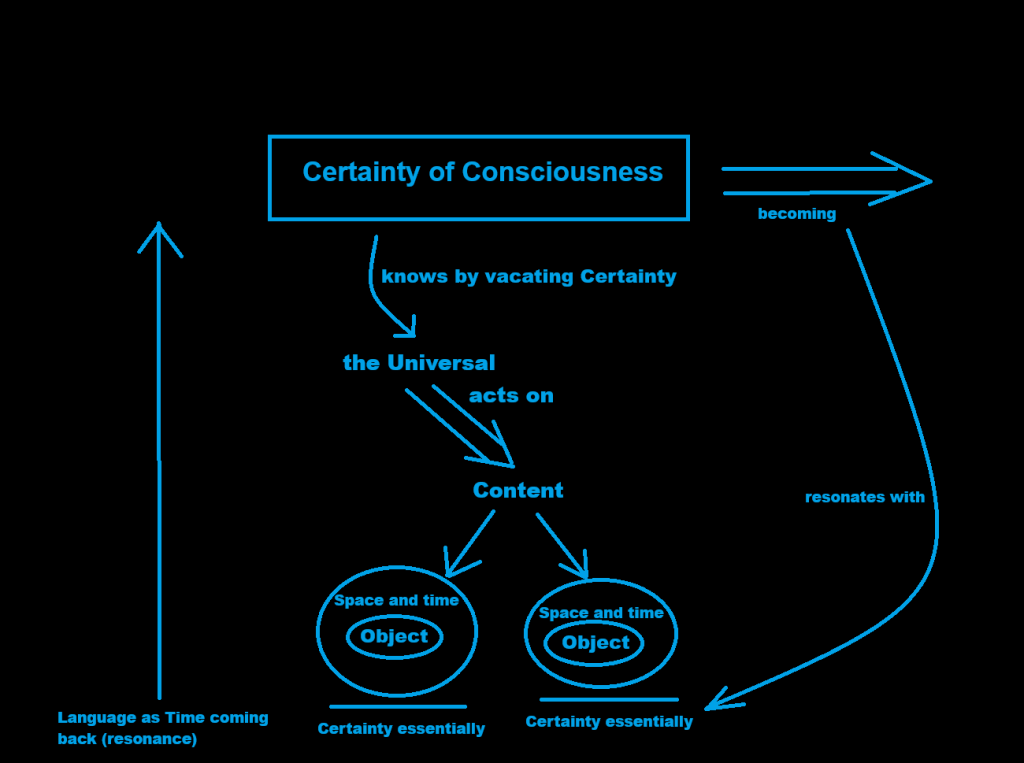
The conclusion is that Language is Univocal, that is it is affirmed by the immediacy of that which it describes. The word signifies something as it actually is, and the word simply is in-itself the signified. The door is the door, and to speak or imagine it means its presence where it is uttered, by process of Resonance-the door is thrown at Consciousness the moment it says the word and in doing so Consciousness leaves its Certainty in the door and becomes transformed with a new proclivity for Uncertainty which allows itself to actively engage with the Univocal object that has been said, all while simultaneously, Lived Experience makes the door rounded and enclosed, pacifying it into material Certainty, for it ought to open and close in the spatio-temporal boundaries that Certainty compresses the door into. This univocity is what allows for things to relate to each other, in the field of communicating. It might be suggested thus, that due to this Univocity, we come to see the primordial form of the Universal.
Unlike the classic sense of Universality, our Universal is not merely something which requires filling with content, rather it is what clutches down content. The Universal participates in the process of transformation, as it signifies univocally and it affirms the presences of objects in space and time by displacing the Certainties of Consciousness into matter, making matter the Universal which acts upon Language in a process that Consciousness returns to as a retroactive Resonance. What is important here is that retroactive Resonance opens up the paradox which we had alluded to previously, that is; genealogy, as defined by process of Consciousness knowing the Universal by vacating its Certainty into an Other-that is matter, then in Universalizing, simultaneously bifurcated Certainty is again in other Objects, making them Certain to be in space and time, while at the same time the vacated Certainty comes back to Consciousness via essential operation of retroactive Resonance, making the Certainty in Consciousness again, appears thus as a semi-enclosed loop. Genealogy, if it were to stretch on for the entirety of the scale at which Certainty is made diffused, then it would not be a genealogy, as the retroactive coming-to-be-Certain of Consciousness via Lived Experience would make it self-enclosed, as Lived Experience does to time. The Universal, at first appearing as an escape for Consciousness to relegate its Certainty into an other, is precisely what enables Certainty to climb out of its own damnation into matter, by Consciousness re-Resonating with the essential certainty of the objects which Certainty has made them self-enclosed-they are spatio-temporal circles which Consciousness finds liking precisely due to its decompressing in Uncertainty. It is no longer a circle, but a circle is appealing due to the thrownness of Conscious affinity to transformation. Retroactive Resonance only restores the operability of being-with, without identity. Therefore, it becomes the observation that genealogy, in Language is not a precise description of continuous, periodic change, as the for-Conscious essence of Language makes it victim to the Resonant re-identification of Certainty, thereby destroying the Universal Nowness of Transition. Linguistic Genealogy, or description, is only accurate insofar it depicts the Universal moment before or after the transformation, as when Consciousness is active in its Perception-toward-Being, that Being is only Universal when it is continuous, but it is made inaccurate, for transformation is discontinuous, and thus in making such an error of description, affirms accurately in the end that the process of transformation is discontinuous, in so far Language can depict the continuous.
Essence as the state-of-Aesthetics and Aesthetic Thinghood
In the previous section, we had come to realize that the Universal is that by which Things are made compressed. In Language, the Universal is first most to Consciousness, for Consciousness in its thrownness can assume to come into contact, or to touch the different Things. Contacting lends naturally to Certainty and the triadic schematic that we had come to describe previously. However, another problematic is already arising, one which lays in the natural appearance of Things. Appearance here we take as the actual aesthetic quality of a given Thing; its color, shape and style. We had only been able, in our advance of Linguistic Univocity, to describe transformation generally in terms of discontinuous totality, that is, in how re-Resonance and the Universal organize both the potential-for-Certainty and matter respectively. We had thus not been able to show a continuous process, given the contractions of Consciousness into its active and subsequent passive form. The genesis of the Aesthetics of Things were not been able to be grasped, precisely because genesis lies in the discontinuous movement that itself is Uncertain both for the genealogy of Consciousness and for the Things taken in possession. Remembering one’s birth, for example, is notoriously an impossible task, for it is a moment of Uncertainty; one’s Consciousness was in the active state of being thrown, quite literally, into the World. Therefore, the new problematic is one that directly lies in the moment that our analysis had started, in the Other. Being informed by own’s birth by Others is the most direct representation of the process of re-Resonance that we had described. In the process of being born, there was no presence of Lived Experience, and so no genealogy do describe what the World was and therefore, no Certainty. Language, consequently was underdeveloped, and thus what lay before is the simply universality of the present moment, which although possessing a likeness of the somber reflection of standing before a farmer’s field in Certainty was by itself Uncertain. We see a new process developing, that being an Aesthetic change. Aesthetics are arguably the most vulgar expressions of meaning-they rest on the experiential notions of the subject, for which Others come to know the most primordial and in some cases, perverse notions. This leads into the conceptualization of transformation whose first-most cause is in the Aesthetics themselves, which although seems counterintuitive, is perfectly aligned with the process of Perception. But in what sense does transformation occur then, through the Aesthetics of the Thing?
Linguistic Universalization, as a process is, as we had established, discontinuous. There is only the result lacking process. This is because of the simple fact that Certainty rounds up mistakenly the origin of the active moment. The intense moments where the most active expression of thrownness under forces comes to fruition in the Uncertainty, are overpowered by the coming back of Lived Experience, in which matter is made to conform to the futurity of the coming re-Resonance; Lived Experience is precisely slingshotted from Consciousness in the Uncertain encounter and in coming to see what the surrounding spatiality of the moment is, Lived Experience molds the vacuum that shrouds Consciousness in intensity into the solidified matter that then is made the active future for Consciousness. Consciousness persists through Universalizing the experience in Language. There is thus a genealogical record missing of the Aesthetic qualities of that Uncertain moment which had come to lay in the past. We cannot, for instance, recognize how the moment of birth looked like, how it smelled, how it felt, nor the color of being pre-Conscious. The Linguistic Universal appears as the superior notion, one which describes what actually happened; we were an infant and did not know. However in coming to know what the Aesthetic qualities actually were, by Others in their Lived Experience, we come to realize that the super sensuous description of the event was in fact incorrect in the perceptive publicity of the moment. Others know that the event was at such a time and in such a space and we did not know of that. It appears then that the Aesthetic state which had existed at that moment of Uncertainty was the true Universal, one in which thee experience was the most primordial and genuine for Consciousness in its Perception-towards-Being. The moment at the time could be said to genuinely be under the term “is”, instead of was. The presence thus of the Linguistic Universal is the negative to the State-of-Aesthetics, that being the actual moment that pertained the coning-to-encounter the Vacuum through Uncertainty.
We thus designate the Linguistic Universal and the Universal-as-Universal, which the latter originates in the State-of-Aesthetics. The interplay between these two directly leads into the realm of difference itself. Difference in the sense of the Linguistic Universal is itself a Universal. Here the described Thing is made determinate simply because of the negation of the Thing from the multiplicity of its Aesthetic-determinacy of its inner own-most realm. The Linguistic Universal is the Universal for which matter takes its orientation. It enacts the forming of substance, making the Universal substantial in its removal of the multiplicity of individual Aesthetic states. This is also why Language pertains to its affinity to the spatiotemporal; matter-as multiplicity is made to be formed by the three-dimensional structure of the sentence and word in subject-object, future-past, verb-noun forms. The substantial criterion for which Language designates Difference qua Universal is through being substantial. The summing, or adding of substance qualifies for the determinacy of the Thing by virtue of being formed. Substantiality, has the essence thus of being-for-Certainty, as it is the medium by which Lived Experience actually makes truth of the things that are presented, thereby making genealogy. This process we may come to designate as rationalization. In rationalizing the already-caused moments, the hierarchy of substantial aggregates as Things comes to appear as that which is most substantial in being able to take accountability of its own potentiality. Accountability therefore causes the reduction of the potential encounter into coming-to-meet the same substance, or the Certain Conscious. However, due to the accountability of the Linguistic Universal both overshoots the resonance of a Thing with its form and underdetermines. Difference as a Universal comes to presuppose the continuousness of the formed genealogy by Lived Experience, due to the Thing being removed form being in the Universal. It is through this gap in determinacy that invites the Uncertain moment, in which Language is not present due to substance itself being decompressed and in turn encompassing the Aesthetic Universal-as-Universal that remains informatically positive not only in the sense of authentically being-for-the-thing, but that it communicates the presence of the Thing in its encompassing of its State-of-Aesthetics and by extension, Consciousness as well. Therefore, somewhat paradoxically, even though the Linguistic Universal seemed to point to a unity of Things qua substance, it happened to be the case that it was in fact the negation of the Things own-most presence in a given field due to the hylomorphism of Language. The Universal-as-Universal is the multiplicity of the Things presence which informs that it is in fact, totally present in Consciousness united in authentic expressions of meaning, independent of rationalizing vacancy qua substance.
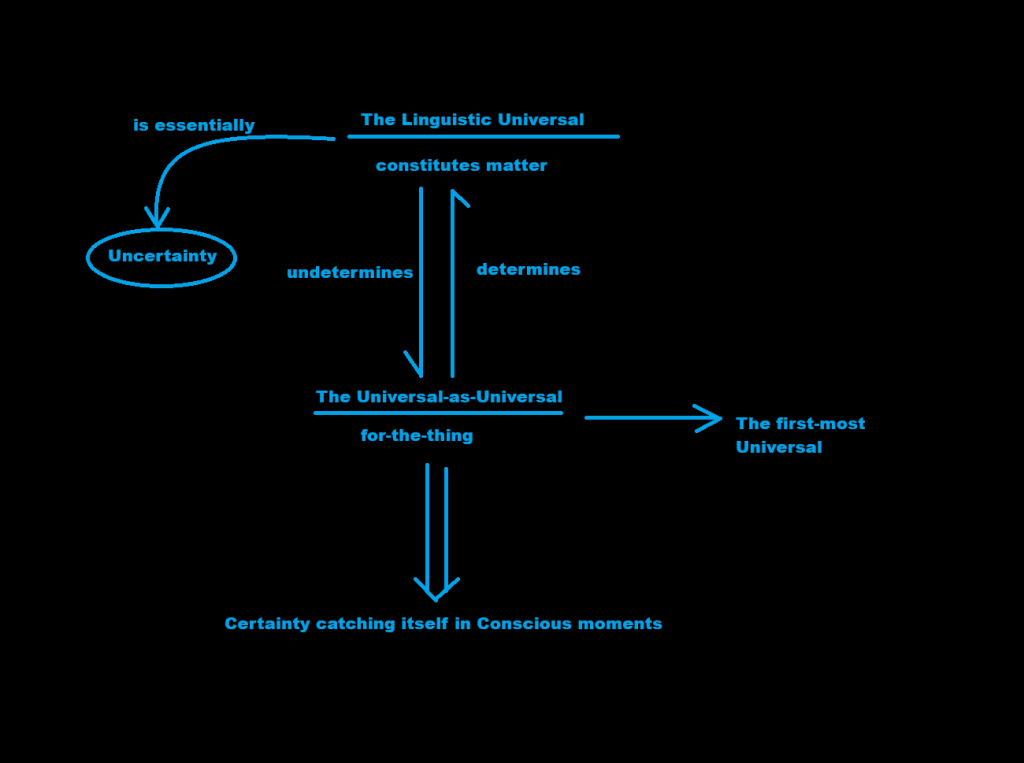
We have thus seen how rationalizing, or the act of taking the Linguistic Universal, comes to take away Certainty as being in the aesthetic moment in which determinacy was in the multiplicity of the Things. Thus the Universal-as-Universal is oriented towards Certainty as being able to catch itself later, or as being contingent in respect to itself-it is Certain that the Certainty of the Consciousness is able to take accountability for itself, in the moment of self-preservation. However, in the assumption of accountability and consequently, in the extinguishing moment of the Universal-as-Universal in Language, the accountability of Certainty is no longer contingent in the effect of causality, that is, it is no longer required to be contingent at the later stage in time. This can point to the observation that contingency is the simple present-ness of the Things whose essence lies in the contingent Certainty of the Universal-as-Universal, and is indifferent if invoked at a later point-it gives no genealogical record as to its own genesis, as that is taken up as Uncertainty.
What we ultimately therefore come to see is yet another problematic. In circling back to an earlier point of the simple interplay of Certainty and Uncertainty, we only now know of the transitions as discontinuous states whose moment of being significant is now at this exact point, and at this exact moment. What is passed over, or what lies at the frontier of the interplay is still unknown. To illustrate more clearly, we have previously only been able to speak of essences and not appearance. Even in laying out the state-of-Aesthetics, and giving the example of birth, we are still in darkness as to the actual content, or the actual appearance of the state-of-Aesthetics. Therefore, the question is: How do we reconcile the aesthetic appearance and the essential interplay of Things with the absence of substance? In the stage of Linguistic Universals, we of course designate the difference as the overarching factor which takes possession of the simpler Universals that are Universal in their own contingency and thus assume the content of Language to be that of the things at the lower order. Similarly, the most aesthetically vulgar, that being the Universals whose contingencies are Certainty catching itself, there is still an open wounds, and a rift. Where is contingency transported to in the moment of Certainty being contingent? That hones our problematic on that fact that, in the hierarchy of the dual Universals, there must a third force influencing the entire process; a motivating factor, so to speak, for both of the moments.
That factor appears as Void, or the nothingness that is formed as the pre-given moment and the incoming futurity of contingency. In its content, Void appears the absence of substance, which we had described in a preliminary way earlier. However it is in this absence that the aesthetic presence of a first-most Universal is affirmed. It comes to be that the Void is actually ever more present in the interiority of a Thing’s aesthetic thinghood- it is the source of orientation by which Consciousness can claim to be taken possession of or inversely, to dwell in aesthetic and universal Certainty. It is not the case as we may have analyzed earlier, that it is through the comparison of Uncertainties and Certainties that we can assuredly take account of an exterior or an outside located outer most fringes of whatever metaphysical realm, rather it is such that the genesis of Things is precisely sourced from the Void, in which the Void is come to be spatially integrated within the thing-itself, in its own interiority by which its exteriority can be relation and consequently ,the individual Thing by which we can perceive for ourselves via Basic or Active Perception. Therefore, it is through the Void that the ontological genesis and furthermore, contingency can form as the duplication of ordinate states; it happens at the same time, and in the same space as where there already happens to be something, it is more-than-one in terms of how it comes to spatially posses a location in time and space. It is thus integrated into the multiplicity of the various Others, whether they be other Things or Other Consciousnesses.
The task ahead now is to determine the subjectivity of the Void in its relation to spatiality and temporality. What we mean is that, we have at this stage analysed a similar triadic structure akin to Basic Perception-a uniquely self-referential triad in which Consciousness had played the role as the definite receiver of subjectivity. It happened to be the case that subjectivity was integrated into to the genealogical Lived Experience and to the pre-informing of futurity as Consciousness had encountered itself in its own thrownness into a capturing of the Linguistic Universal in contrast to the Aesthetic Universal of genesis. The Void, that as we had come to know, is present in regards to the interior of the given structure between the taking of Universals in the realm of Language. It is from this that we had completed the triad of Perception-toward-being, precisely from the return of the dammed element; the intense moments that acted as breakdowns in Lived Experience and genealogy had in their Void-spaces condemned the Other-Universal in Language. However, crucially, they had been affirmed to exist in regard to their presence-they had been present in the intense moment as the informing absence, or in other words, the pre-genesis linguistic notions of subjectivity. Therefore, the primary assertion becomes that presence itself was something self-transcendent across all realms of Perception. It cannot be said intensity is the total end of what it appears to be; it is generative in regards to the affirmation of the contingency of the Other in another moment of time. It guarantees the presence of the forms that are related to another space, that paradoxically, is itself non-spatial or non-temporal in how it is Perceived in moments. That assertion of the Paradox, that is the inter-presence and self-transcendence of polar forms across all realms of space and experience, brings us to the question of the There; how is the Thereness of a moment constructed and determined, if it is the case that interaction and transformation in regards to the communication between a structured system and a pre-individual field points to affirmation, instead of a negation of the Universal? What is thus left in regard to the world hood, as in the unity of experience and its assumed stability?
The There: Potentiality as a prerequisite for the Actual
In the earlier section, we had come to know the Void, and we had formulated that the Void is the immanent source of genesis for Consciousness, as the movement of Certainty into Uncertainty, and consequently the taking of the state-of-aesthetics, comes to in actuality, be something virtual and simulated. What we mean precisely, is that the Void is, by virtue of its self-transcendence, a generative horizon that due to its openness is dark and cavernous, it contains no direct essences that point to a relation between it and something else on its own accord; instead it is always situated in the interior and inside the things-in-themselves. It is thus neither the purest absence of substantiality, nor is it the Absolute Negation, instead it is the genetic field that operates in extensive operations of relations, and it comes to be accountable for the relations that form the basis of ontology. The Void is therefore the field that pre-informs The Paradox; if it happens to be the case, for instance, that it is day outside, the the Night is in the void and is present in the interiority of the day, and consequently, the darkest of Nights are in fact, bright in their interior. It is therefore a question of how, and by what process, this comes to be. In this, we shall analyse this problematic, and use it directly to formulate the stability of the There, and the worldly harmony which forms the basic phenomenology of everyday experience. The stakes of this operation are evidently high, as even though we may speak of ontological dynamics and operations, the explanations for the moment of everydayness that make possible the phenomenology of ontology are yet to be found.
We can assume via the simple earlier formulations, that the composition of the There, that being the reasons for which the There is justified against opposing forces of the un-There, is inherently triadic in its structure, as it is inevitable that minor composing parts of the There, which are the universals of Perception (Certainty and Uncertainty), are in themselves the aggerate triads composed of the respective horizons for which the whole of Perception is distributed. This aggregation can give us a clue therefore, as to finding the There in a moment, where inasmuch the respective horizons can transcend each other and reconstruct stability and progressive higher levels, the There is something which is inherently the sum of all of these operations. It would appear naturally necessary that the There, by whatever mechanism or dynamic, would amount to the realization that, on the most basic level, it is the supersession of one Uncertainty into Certainty and on the contrary Certainty into Uncertainty in the moment of the Death of the subject. There would be the urge, or necessity to claim that the most numinous of phenomena, whether they be the Absolute, Nature or the Void, are inherently on the side of the sensible realm-that there is no necessity in-itself placed on the things which are utmost phenomenologically unaccountable for, in the framework of where self-transcended Things can amount to the answering of the most basic problematic of managing an abstract unity of subject/object, self and other. Our earlier discovery of the Void thus could easily be amounted to formulating, by virtue of the transcendental urges, that it is something unnecessary in-itself; there would be no rational reason to engage in the pre-genealogical genesis by virtue of immanent mediation qua Thereness and Un-Thereness respectively.
We shall come to see that contrary to the intuition that indeed mediation is the ultimate definite stabilizer acting in service to making the There possible, that is in truth the case that the There is something which in reference to the state of the Void, (remembering here the metaphor of the Birth) is innately constituted by the rather privileged position of Time in the entire system formulated up until this point. Recalling the stated location of Void, gives us the definite relationship of all of the constitutive parts of Certainty and the Void-the interiority of Consciousness on the level of the Self is still exterior to the Void. This preliminarily implies that this relationship is non-substantial, yet still material in nature. Non-substantial materiality thus gives a unique formulation, for it cannot be said that determinacy is at this point universal, it is something still lingering in the Universal-as-Universal and in the State of Aesthetics. The determinacy of the Void cannot be taken to be in accordance to material, and thus is something which is primarily still determined with the relation of non-substantiality, given the appearance of the Void as being unable to be distinguished in the case of a complete enclosure by space. Time is thus something which is concentrated as the Void itself; in the relativity of both time and space and due to their un-seperation as well, the Void represents a genetic point at the lower dimensional order. A single dimension can thus be assumed to represent Time, where in the case of determinacy qua universal, it is taken as discontinuous in the segregation of a Universal Now-in setting the ground of a a rapport of Actuality, it is indeed the case that the lower dimensional orders are separated as distinct parts, while the immediacies present of the three-dimensional are made in the moment the immediacy for which we designate Certainty. This is exactly what we saw in the case of Birth; it was that the Nowness of the moment was taken up by space, as the separation of time.
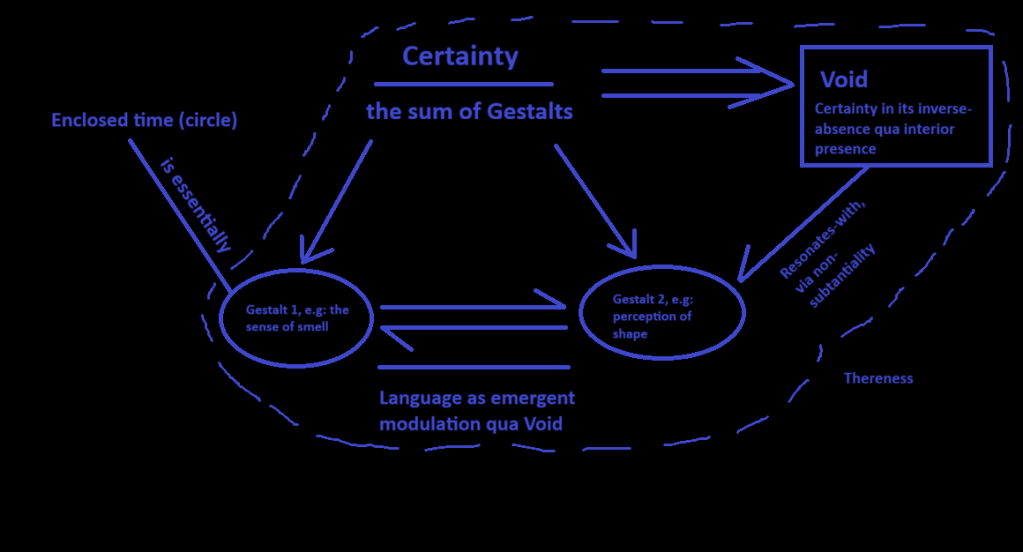
What the There could be, that being its potentiality, is as we had formulated in the univocity of Language, pre-informed by contingency, as phenomenological investigation had given us the first-most reason for explaining necessity of the moments-that it is indeed the case that the most phenomenologically distant Things are indeed necessary via the historicity of Lived Experience. Therefore, if we keep in account the discontinuousness of Time across Space, we appear to already posses preliminary conceptualization of Thereness. It is the case that Time, in the moment of separation in Perception-towards-Being, is made to be aggregated into units of Gestalts. These Gestalts are what inherently allow us to clarify the positioning of Language within our ontology; the Gestalts are informational units of simple counting, it is as we had discovered initially even, the rounding of the timeline into a circle, as was the case with Basic Perception. Language is therefore nothing but the counting and summing, hence adding or subtracting of these Gestalts. It happens to be that the oppositions that were only perceived unified in discrete units of Gestalts, whether they were the temporal separation charactered by rounding or the making-concave of the timeline at the hands of Lived Experience, where it was Certainty that was the immanence of the discontinuous Gestalts in the moment of enclosure, that it had been perceived that sensuous unity had been achieved.
 Hyperpsych